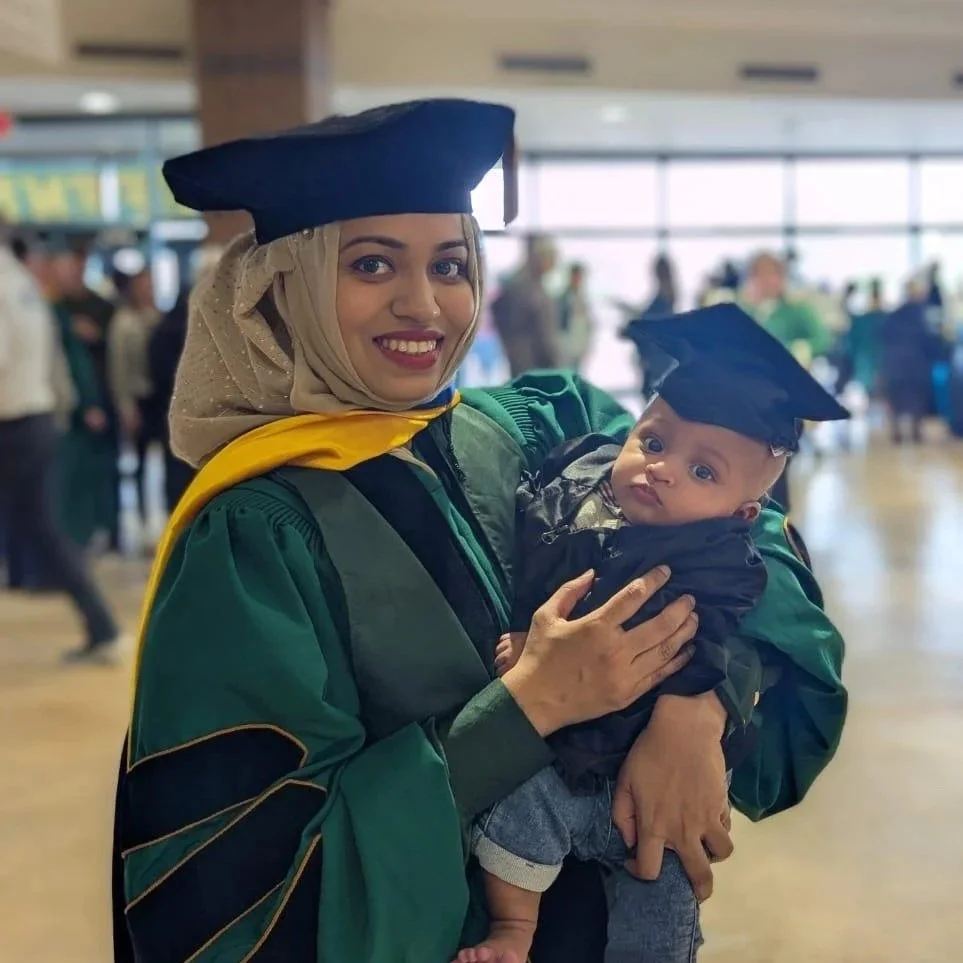
Kazi Sarjana Safain
Kazi Sarjana Safain is a Nutrition Core Laboratory Manager at North Dakota State University and a mother of one. Her research focuses on understanding how nutrition influences growth, metabolism, and long-term health. In this inspiring interview, she shares how she navigated her PhD research abroad as a mother of a newborn, without any family support. As a first-generation PhD from Bangladesh, she aspires to mentor and inspire women, mothers, and students from underrepresented backgrounds in STEM.
1. Please describe your job in one sentence.
I am currently a Nutrition Core Laboratory Manager at North Dakota State University, where I support research in animal nutrition, physiology, and metabolism through laboratory management, experimental coordination, and analytical support.
2. What do you aspire to accomplish in your career and why?
I aspire to build a meaningful career at the intersection of nutrition, metabolism, and developmental biology, where my research can contribute to healthier animals, more sustainable livestock production, and improved understanding of how early-life nutrition shapes long-term health. Beyond my scientific goals, I hope to become a mentor and role model for women, mothers, and students from underrepresented backgrounds in STEM. My journey has been shaped by both challenges and support, and I want to help create a more inclusive scientific community where talented individuals do not feel limited by motherhood, background, or societal expectations.
3. What do you consider to be your most important career achievement or milestone?
My most important career achievement is the journey of earning my Ph.D. in the United States with a fully funded scholarship at an R1 research institution. Coming from a middle-class family and being the first in my family to earn a Ph.D., this journey was not easy, especially without a strong academic background or consistent moral support to guide me through the process. During the last year of my Ph.D., I had my first baby, which made the journey even more challenging as I tried to continue my education while caring for a newborn without family support nearby. Looking back, I consider this entire journey, persisting through uncertainty, motherhood, and academic pressure, to be my most important achievement because it reflects my resilience, courage, and commitment to building a better future for myself and my family.
4. What career obstacles have you faced as a mother in STEMM? How did you overcome them?
One of the biggest obstacles I have faced as a mother in STEMM is learning how to balance my career goals with the time and emotional energy my child needs. I want to continue building a strong research career, staying involved in leadership and volunteer activities, and contributing meaningfully to the scientific community. At the same time, I deeply want my child to have a happy, loving, and memorable childhood.
Balancing these responsibilities has been challenging, especially because both science and motherhood require commitment, patience, and presence. I have overcome this by becoming more intentional with my time, setting priorities, accepting that I cannot do everything perfectly, and learning to ask for support when needed. Motherhood has also made me more resilient, organized, and focused. It has taught me that success does not always mean doing everything at once, but continuing to move forward with purpose while caring for the people who matter most.
5. What was the best professional or personal advice you’ve ever received?
One of the most meaningful pieces of advice I received came from one of my Ph.D. advisors, who told me, “You cannot truly grow until you raise a child”. This advice continues to remind me that personal growth and professional growth are often connected, and that motherhood can be a powerful source of strength rather than a limitation.
6. How did MiS help you professionally and/or personally?
Mothers in Science has helped me feel seen, supported, and inspired. It is very encouraging to see so many mothers balancing their careers with raising children while also contributing to science, leadership, advocacy, and community-building. Seeing their stories reminds me that I am not alone in this journey.
7. What advice would you give to a mother in STEMM?
My advice to other mothers in STEMM is to stay consistent and keep moving forward, even when life feels unpredictable. Motherhood can bring many challenges, but it is not a barrier to success. In fact, it can make us stronger, more focused, and more resilient. All great things in the world have happened through resistance, uncertainty, and difficult times. So, when the journey feels hard, it does not mean we are failing; it may mean we are growing.
Instagram: @sarjana.safain
Facebook: @sarjanashejuti