
Margaret Hamilton
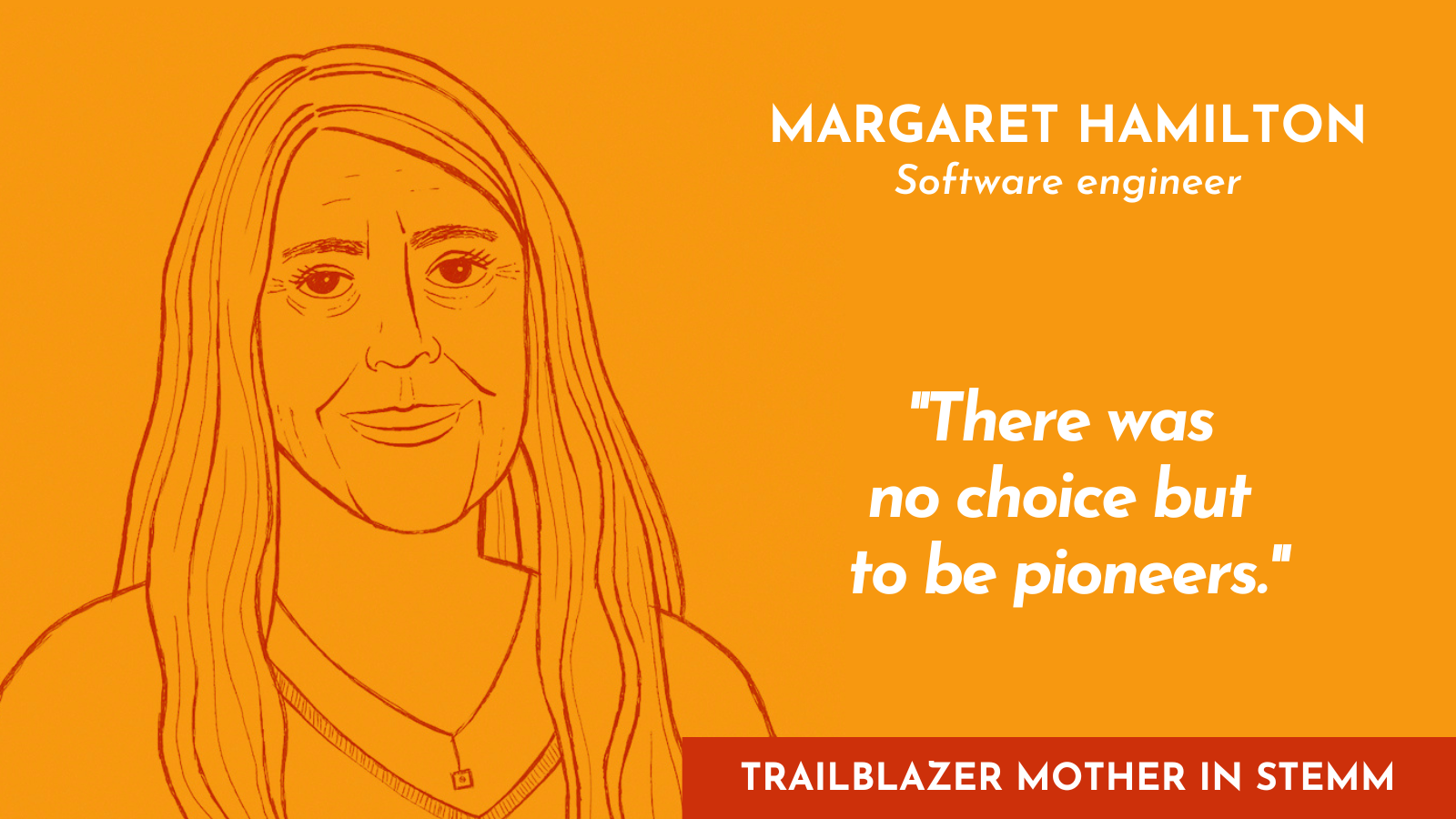
Margaret Hamilton (born August 17, 1936) is an American computer scientist best known for leading the development of the on-board flight guidance software for the lunar missions of NASA’s Apollo Space Program and for coining the term “software engineering”. She is also a mother in science who speaks openly about the realities of balancing a demanding STEMM career with caregiving.
Hamilton grew up with a deep curiosity for mathematics, shaped in part by philosophical conversations with her father during long drives through Michigan’s Upper Peninsula. She earned her degree in mathematics, with a minor in philosophy, from Earlham College in 1958, where she met her first husband, James Hamilton. The couple moved to Boston after her graduation, where she initially planned to pursue graduate studies in mathematics at Brandeis University. Instead, she accepted a position at the Massachusetts Institute of Technology, programming software for weather prediction while also undertaking postgraduate work in meteorology. During this period, still in her early twenties and teaching herself to program on the job, at a time when computer science was not yet a formal field of study, she gave birth to her daughter, Lauren Hamilton.
From MIT's meteorology department, Hamilton moved to MIT’s Lincoln Laboratory, where she worked on the Semi-Automatic Ground Environment (SAGE) project, a Cold War-era US air defense system. She was reportedly assigned a particularly difficult program that others had been unable to run, and whose notes by the original author were written in Greek and Latin. She not only got it running, but did so while raising her daughter, often with her by her side in the laboratory during long working hours.
“My daughter Lauren would often come to work with me at nights and weekends, because we were all so dedicated. There wasn't a time when we weren't working. She liked to play astronaut because she saw me playing that way in certain simulations we would run”, Hamilton said in an interview.
When she joined the MIT Instrumentation Laboratory in 1965 to work on the Apollo program, computer science remained an emerging field with no standard practices or formal recognition, and much of the software development work remained behind the scenes. Within this context, Hamilton went on to lead a team of nearly 100 engineers, mathematicians, and programmers as Director of the Software Engineering Division, overseeing the development of the on-board flight software for NASA’s Apollo Guidance Computer.
On nights and weekends, the hours when she often did her most intensive work, her daughter played among the racks of computers and tangled wires while Hamilton wrote code. When asked later about work-life balance during those years, Hamilton was direct:
"Being young helped! Also, I made sure to spend as much time as possible with my daughter by taking her to work with me during nights and weekends."
She also acknowledged that her husband James shared domestic responsibility, describing herself as "fortunate to have a very modern husband who understood equality." Hamilton and James divorced in 1967, during the height of the Apollo program, and she later married Dan Lickly in 1969. Through those years of personal change, her work continued without interruption.
In 1968, while Hamilton was preparing simulations for the Apollo missions, her daughter inadvertently triggered an error on a simulator by selecting a program intended for a different phase of the mission, revealing a vulnerability in the system. Hamilton immediately understood the implication: if a child playing on the simulator could trigger this sequence, a trained astronaut under mission pressure absolutely could too. She proposed a fix. Her superiors dismissed it. Astronauts, she was told, were too well-trained to make such a mistake.
That philosophy was put to its ultimate test on July 20, 1969. Approximately three minutes before the Apollo 11 lunar module was scheduled to touch down on the moon, the guidance computer, overloaded with instructions from a radar system that should have been switched off, began flooding mission control with alarm codes. Hamilton's software was built to prioritize critical tasks and shed lower-priority processes during an overload. It held. Neil Armstrong and Buzz Aldrin landed safely, and her team's software was, as she later said, the first to run on the lunar surface.
Hamilton is widely credited with coining the term "software engineering," reflecting her conviction that software development should be treated with the same rigor and recognition as hardware engineering. Her technical contributions were equally foundational. She pioneered concepts of asynchronous software, priority scheduling, and end-to-end testing. She developed error detection and recovery systems that were designed not to prevent every possible mistake, but to handle mistakes gracefully when they inevitably occurred, a philosophy rooted in a conviction she held throughout her career: that "the never-going-to-happen can happen."
After Apollo, she co-founded Higher Order Software in 1976 with Saydean Zeldin, then founded Hamilton Technologies in 1986. She published more than 130 papers over her career. She received the Augusta Ada Lovelace Award in 1986, the NASA Exceptional Space Act Award in 2003, the largest cash prize NASA had ever awarded to an individual, and in 2016 the Presidential Medal of Freedom, presented by President Barack Obama. Hamilton's story and achievements are a powerful reminder of what becomes possible when caregiving and scientific life are allowed to coexist.
Published on 08/05/2026
Written by Sarah Williford
Edited by Alma Fleitas and Isabel Torres
References:
[1] Britannica, "Margaret Hamilton," Encyclopædia Britannica. Available: https://www.britannica.com/biography/Margaret-Hamilton-American-computer-scientist
[2] MIT News, "Apollo code developer Margaret Hamilton receives Presidential Medal of Freedom," 2016. Available: https://news.mit.edu/2016/apollo-code-developer-margaret-hamilton-receives-presidential-medal-of-freedom-1117
[3] NASA Science, "Margaret Hamilton." Available: https://science.nasa.gov/people/margaret-hamilton/
[4] MIT Technology Review, "Margaret Hamilton," 2019. Available: https://www.technologyreview.com/2019/08/16/579/margaret-hamilton/
[5] Smithsonian Institution, Women's History, "Women of Apollo," 2019. Available: https://womenshistory.si.edu/blog/women-apollo
[6] Kartaca, "On Margaret Hamilton, Apollo 11, and software engineering," 2020. Available: https://kartaca.com/en/on-margaret-hamilton-apollo-11-and-software-engineering/
[7] R. C. Friend, The Women of Apollo, Cascade Pass, 2006. ISBN: 9781880599792.
[8] D. Di Piazza, Space Engineer and Scientist Margaret Hamilton, LernerClassroom, 2017. ISBN: 9781512456318.
[9] Computer History Museum, Oral History of Margaret Hamilton, interviewed by David C. Brock, recorded April 13, 2017, Boston, MA. Catalogue no. 102738243. Available: https://www.computerhistory.org/collections/catalog/102738243